What an AI Tool for Wrap Shops Should Actually Do
A practical look at how Wrap Proof Extract™ helps wrap shops turn messy AI-generated mockups into designer-ready rebuild briefs instead of wasting unbillable interpretation time.
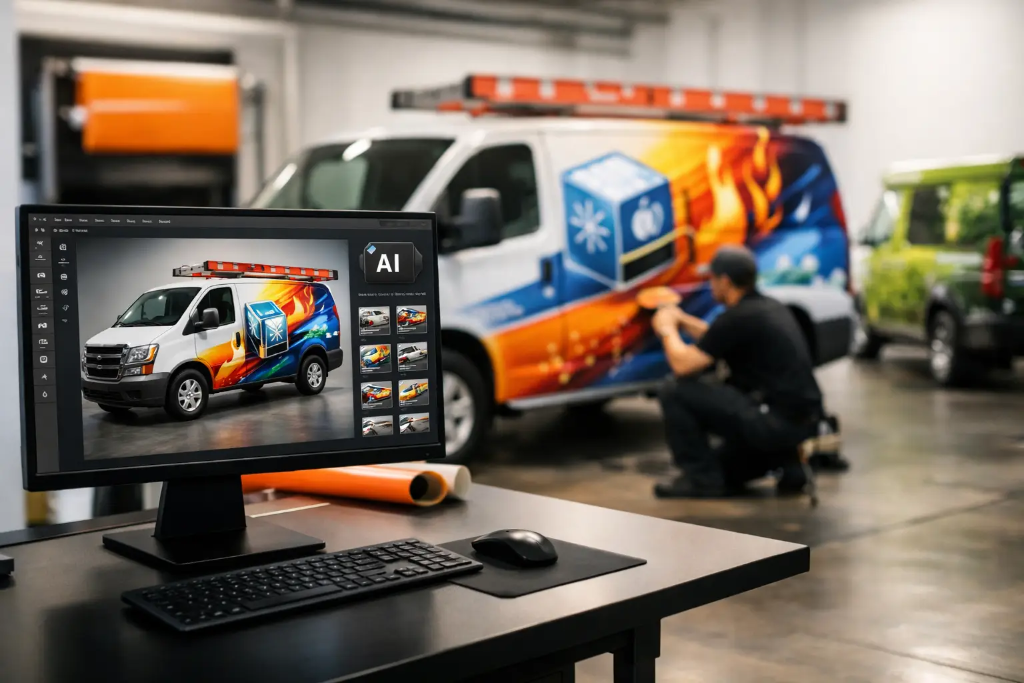
A customer walks in with a wild AI mockup on their phone, wants it on a Transit by Friday, and swears the last shop said it was "basically ready to print." That is exactly where an ai tool for wrap shops should earn its keep. At https://wrapextractor.app/, the point is not to pretend a flat AI image is production-ready. The point is to run a Wrap Proof Extract™ and get a practical Rebuild Brief your designer can actually use.
What an ai tool for wrap shops should actually do
Most shops do not need another shiny app that makes prettier concepts. They need fewer dead-end proofs, fewer back-and-forth emails, and less time burned trying to reverse-engineer nonsense. When a customer brings in an AI-generated wrap concept, the real problem is interpretation. You are looking at flattened effects, made-up typography, impossible reflections, and graphics that do not respect body lines, door seams, bleed, or install logic.
A useful ai tool for wrap shops should work like an asset detective and interpretive workflow blueprint engine. It should study the proof and tell your team what it is likely made of. That means font clues, color palette guidance, graphic element breakdowns, and production notes that help a real designer rebuild the job for print production.
That is the difference between a novelty tool and an operational tool. One creates more questions. The other gives your shop a clearer starting point.
The real cost of vague AI proofs
Anybody running a wrap shop already knows the pain. The customer thinks they handed you a design. What they really handed you is a reference image with hidden labor attached.
Now your designer is zooming in at 300 percent, trying to identify type styles from warped text, estimate gradients from compressed screenshots, and figure out whether the "metal" effect is a printable texture, a stock photo look, or just AI hallucination. Meanwhile, your estimator is stuck because the scope is fuzzy, and production cannot schedule cleanly because nobody knows how much rebuild work is involved.
This is where margins leak. Not in the material quote. Not in the install. In the unbillable interpretation time before the job is even truly defined.
For fleet graphics and repeatable commercial work, the problem gets worse. One vague proof can turn into multiple vehicle variations, each needing its own adjustments for scale, panel breaks, and vinyl tracking. If the original concept is unclear, every version downstream takes longer.
Why general AI tools fall short in print production
General AI image tools are built to impress the eye, not support the shop floor. They are good at mood, style, and visual drama. They are not good at giving a designer production logic.
That matters because wrap production is full of constraints. A concept might look great in a front three-quarter render and still fail once you account for wheel wells, handles, rivets, channels, and the simple fact that vehicles are not flat canvases. Text that reads well in an AI image may become unusable once stretched across panel geometry. Colors may shift from glow-heavy fantasy to muddy output when translated to real-world print conditions.
So the issue is not that AI proofs are useless. The issue is that they are incomplete. Shops still need a bridge between inspiration and execution.
How Wrap Proof Extract™ fits the workflow
Wrap Proof Extract™ is built for that bridge. Instead of acting like a magic button that skips design judgment, it performs a forensic analysis of the uploaded proof and returns a designer-ready Rebuild Brief.
That brief gives your team practical clues. It identifies likely font directions, maps out the visible color palette, breaks down major graphic elements, and adds production notes that help a real human rebuild the concept with print and install in mind. If your shop has ever had a designer lose half a day just trying to decode what the customer meant, that is the problem this process is aimed at.
The workflow is simple because it needs to be. Upload a proof, get a structured brief, and decide whether the job is worth moving forward as quoted, needs revision, or needs a more realistic production conversation with the customer. That speed matters at intake because it helps you qualify jobs before they clog up the schedule.
For independent business owners, the value is just as clear. If a contractor, food truck owner, or local service business used AI to mock up their dream wrap, they can run it through Wrap Proof Extract™ first and bring a more grounded brief to their installer. That can save a lot of confusion and reduce the risk of paying for manual interpretation that still starts from scratch.
The under-$8 advantage matters more than people admit
A lot of shop owners do not mind paying for tools. What they hate is paying for tools they only need sometimes. That is why the sub-$8 price point matters.
At less than $8 per extraction, this is not a budget debate. It is a workflow decision. If one vague AI proof eats even 20 to 30 minutes of designer time, you are already spending more than that in labor. In plenty of shops, the real number is much higher, especially when a salesperson, designer, and production manager all touch the same unclear concept before anyone realizes it needs a rebuild plan.
The other thing operators appreciate is the lack of subscription fatigue. Some tools make sense as daily software. This kind of workflow support often does not. You might need it three times in one afternoon and not again until next week. Paying only when you need it matches how wrap shops actually work.
When this kind of tool helps most
It depends on the job mix, but there are a few situations where the payoff is obvious.
The first is customer-supplied AI art. That is the big one. The second is quote-stage triage, when your team needs to know whether a proof is straightforward, salvageable, or likely to turn into a scope creep problem. The third is handoff clarity between sales and design. A structured Rebuild Brief gives everybody the same reference point instead of relying on vague notes like "make it look like this but cleaner."
It also helps with revision discipline. When the original proof is broken into fonts, colors, graphic components, and production notes, it becomes easier to explain to customers what can stay, what needs adjustment, and why. That conversation goes better when you are not speaking in generalities.
What it does not replace
A smart shop owner will ask the right question here: does this replace a designer? No, and it should not.
An interpretive tool is most valuable when it reduces waste around skilled labor, not when it pretends skilled labor is optional. Your designer still needs to make judgment calls around layout, scaling, readability, bleed strategy, panel transitions, and final print production setup. Your installer still needs graphics that respect the realities of the vehicle. Your production manager still needs files and notes that hold up under pressure.
What this kind of tool replaces is guesswork at the front end. It cuts down the time spent staring at a customer screenshot and trying to infer the building blocks. That is a very different problem than design execution.
How to judge whether an AI tool is worth using in your shop
If you are evaluating any ai tool for wrap shops, do not start with the demo visuals. Start with the labor question. Does it reduce interpretation time? Does it help your team scope jobs earlier? Does it improve communication between sales, design, and production? Does it give customers a clearer path from concept to printable artwork?
If the answer is no, it is probably another distraction.
If the answer is yes, then the next question is financial friction. Shops are busy, and most specialty tools get ignored when the cost structure feels heavier than the actual use case. That is why a pay-per-use model makes practical sense here. You can use it when the proof is messy and skip it when the job is already clean.
That is also why https://wrapextractor.app/ feels aligned with real shop operations. It respects the fact that not every job needs intervention, but the ones that do can burn serious time fast.
Stop wasting unbillable design hours guessing at impossible AI mockups. Run your customer's concept through a Wrap Proof Extract™ today. For less than $8, upload the proof to https://wrapextractor.app/ and get a complete font, color, and production Rebuild Brief in seconds. No subscriptions. Pay only when you need it!
Turn an AI wrap proof into a rebuild brief.
Upload a customer mockup and get font, color, graphic, and production notes for your shop.